
Hard Money Loan Cash to Close Costs in Massachusetts: A Complete Guide for Real Estate Investors
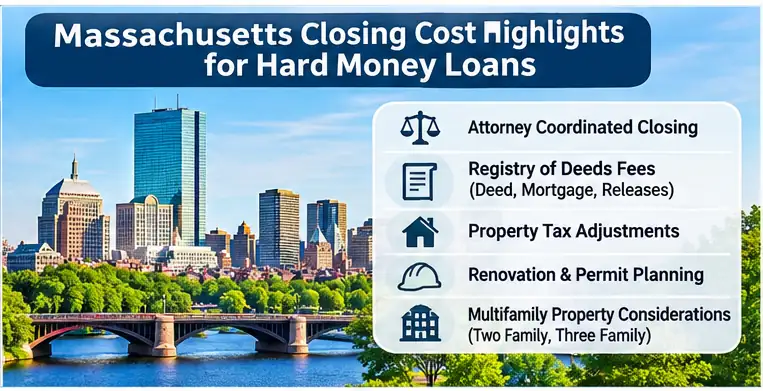
We offer hard money financing for investment property purchases and renovations throughout Massachusetts. Hard money loan cash-to-close costs typically include the buyer’s equity contribution, loan origination fees, attorney and title charges, recording fees, and prepaid expenses, adjusted for earnest money deposits and applicable closing credits.
For real estate investors, knowing the exact amount required at closing is essential for planning an acquisition, renovation, or property investment. The loan amount shown on a financing proposal is only one part of that calculation. The amount available at settlement, the fees collected, and the funds reserved for construction can all influence how much capital an investor needs.
This guide explains how cash to close works, what expenses Massachusetts investors should prepare for, and how to calculate the amount required using a realistic property purchase example.
What Does Cash to Close Mean on a Hard Money Loan?
Cash to close is the amount of money a borrower must provide at settlement to complete a real estate transaction.
For a hard money purchase loan, that amount generally consists of the portion of the purchase price funded by the borrower, applicable closing expenses, and prepaid charges. Funds already deposited toward the purchase are credited against the final amount due.
Cash to close = Purchase price + borrower closing expenses + prepaid charges + required deposits or escrows, minus the lender’s net closing advance, earnest money already paid, and applicable credits.
The calculation may be simpler when the closing statement separately identifies the buyer’s equity contribution and all loan related charges.
For example, consider an investor purchasing a Massachusetts property for $300,000 with a lender providing $225,000 toward the purchase.
The investor’s initial equity contribution is $75,000. Loan fees, title charges, legal expenses, and applicable prepayments are added to that amount. Earnest money already paid reduces the remaining settlement balance.
This distinction is especially important for investment properties because borrowers may also need working capital for renovations, monthly interest payments, insurance, and property operating expenses after the purchase.
What Costs Are Included in a Hard Money Loan Closing?
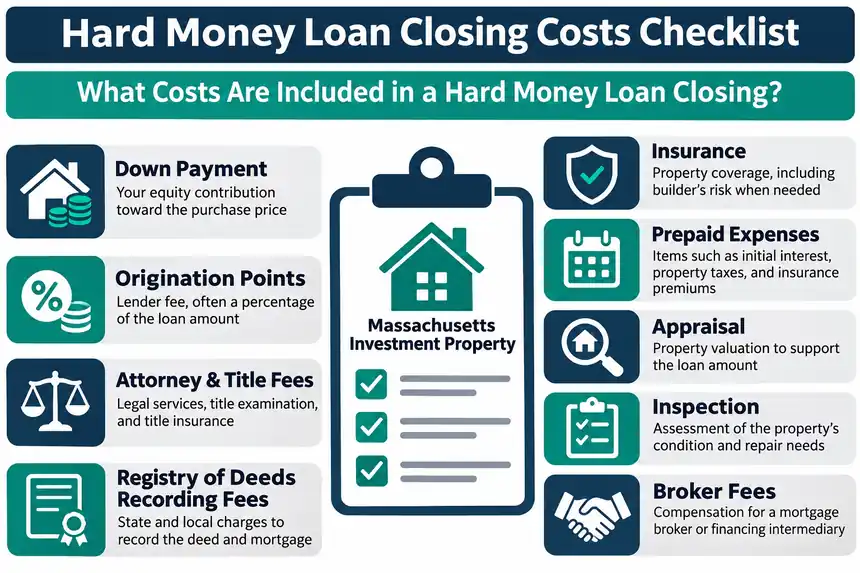
Several expenses contribute to the final settlement amount. Understanding each category makes it easier to compare financing proposals and prepare an accurate investment budget.
1. Down Payment and Borrower Equity Contribution
The down payment is usually the largest component of a hard money loan’s cash to close requirement.
It represents the portion of the purchase price that the investor contributes while the lender finances the remaining approved amount.
Hard money lenders often evaluate the equity contribution using the property’s value, acquisition price, and proposed financing structure.
One commonly used measurement is the loan-to-value ratio, or LTV.
Loan to value ratio = Loan amount ÷ Property value × 100
Consider an investment property purchased for $400,000.
If the lender approves a purchase advance equal to 75% of the acquisition price:
Loan amount = $400,000 × 75% = $300,000
Borrower equity contribution = $400,000 less $300,000 = $100,000
The borrower therefore contributes $100,000 toward the property purchase before accounting for settlement expenses.
The actual financing percentage depends on the lender’s valuation, the property, the transaction, and the approved terms.
2. Hard Money Loan Origination Fees and Points
Loan origination fees compensate a lender for arranging, underwriting, and funding a real estate loan.
These charges are frequently expressed as points.
One origination point equals 1% of the loan amount used to calculate the fee.
For example, on a $250,000 loan:
| Origination points | Fee amount |
|---|---|
| 1 point | $2,500 |
| 2 points | $5,000 |
| 3 points | $7,500 |
| 4 points | $10,000 |
These amounts demonstrate the calculation rather than a universal fee schedule.
A financing proposal should identify the origination percentage, the amount used to calculate the charge, and whether payment occurs at settlement or through a deduction from loan proceeds.
For renovation financing, it is particularly important to confirm whether points are calculated using the entire loan commitment or only the initial amount advanced at closing.
The two amounts may differ when part of the loan is reserved for future construction draws.
3. Closing Attorney and Title Examination Fees
Massachusetts real estate transactions commonly involve attorneys who coordinate property transfers, examine title records, prepare documents, and manage settlement requirements.
Depending on the transaction, legal and title-related expenses may include:
- Attorney fees for the purchase and loan closing.
- Title examination and review of existing ownership records.
- Lender’s title insurance premiums.
- Optional owner’s title insurance premiums.
- Preparation and review of mortgage documents.
- Municipal lien information and related property records.
- Settlement administration and disbursement services.
Some services may be included in a combined attorney fee, while others appear as separate settlement charges.
The most useful comparison is the total itemized expense, rather than the attorney fee alone.
For example, a quoted legal fee may cover document preparation but have separate charges for title insurance and municipal searches.
Reviewing these components before closing helps investors understand what each expense represents.
4. Massachusetts Registry of Deeds Recording Fees
Recording fees are an important local expense when purchasing an investment property or recording a new mortgage in Massachusetts.
The appropriate Registry of Deeds records documents establishing property ownership and the lender’s mortgage interest.
According to the official Massachusetts Registry of Deeds Fee Schedule, the published charges include:
| Recorded document | Published fee |
|---|---|
| Deed | $155 |
| Mortgage | $205 |
| Mortgage discharge or release | $105 |
| Municipal lien certificate | $80 |
These published amounts include applicable recording surcharges. The actual documents required and the allocation of charges depend on the transaction.
For instance, an investor purchasing a two family property in Worcester may need a deed and mortgage recorded as part of the acquisition.
A refinancing transaction may involve recording a new mortgage and releasing an existing mortgage.
The closing attorney can identify the appropriate registry, required documents, and fees for the property.
Because published schedules can change, the final closing estimate should use the current fees applicable to the transaction.
5. Property Insurance and Prepaid Expenses
Some expenses must be paid before or at settlement even though they relate to the period after ownership begins.
For an investment property, these may include:
Property insurance: Coverage appropriate for the building’s intended use, occupancy, and condition.
Builder’s risk insurance: Coverage that may be required when the investment involves significant construction or renovation activity.
Prepaid interest: Interest covering the initial period between loan funding and the next scheduled payment date, when required by the loan terms.
Property tax adjustments: The buyer’s share of real estate taxes based on the settlement date and the applicable proration agreement.
Insurance or tax reserves: Funds deposited or retained for future obligations where the financing arrangement requires them.
These expenses vary by property and loan agreement.
A vacant renovation property, for example, may require a different insurance arrangement from a fully occupied rental property.
For investment budgeting, prepaid expenses should be identified separately from the purchase equity contribution and lender charges.
6. Appraisal, Inspection, and Property Review Costs
Hard money financing is secured by real estate, so evaluating the collateral is an important part of the lending process.
Depending on the property and financing structure, the lender may require an appraisal, inspection, valuation report, or review of the proposed renovation work.
A lender may consider the current property condition, comparable sales, potential completed value, and projected rehabilitation expenses.
Some evaluation costs are collected before settlement, while others are included in the closing statement.
When estimating cash to close, record any amounts already paid so the final calculation reflects the remaining balance due.
7. Broker Fees and Additional Lending Charges
Certain transactions involve a mortgage broker or other financing intermediary.
A broker fee, when applicable, may be calculated as a percentage of the loan amount or as an agreed fixed charge.
Additional financing expenses may include document preparation, processing, or other services specified in the loan agreement.
An accurate cost comparison should identify who receives each payment and whether the same service is already covered by another fee.
How Much Cash Do You Need to Close a Hard Money Loan in Massachusetts?
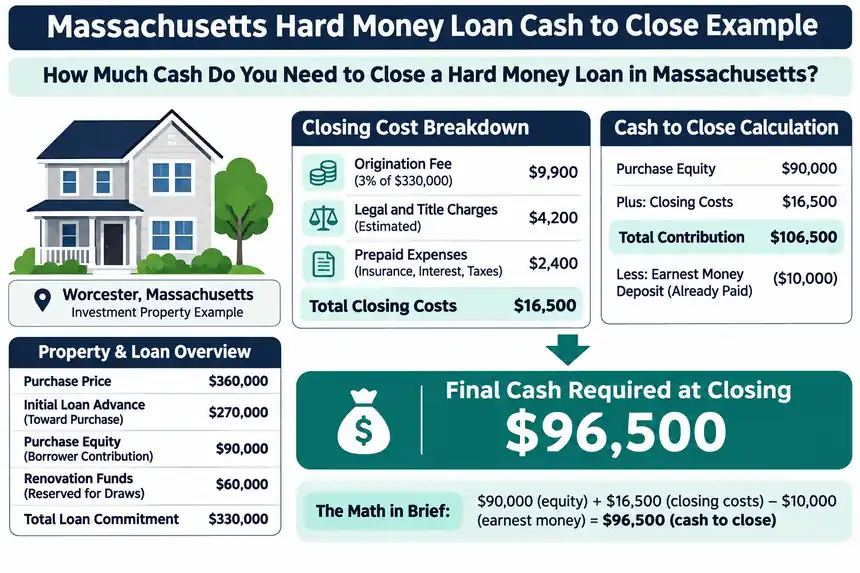
The clearest way to understand cash to close is to calculate it using the purchase price, actual lender advance, settlement expenses, and existing deposits.
Consider an investor purchasing a residential investment property in Worcester for renovation and eventual resale.
The following is a hypothetical financing example using illustrative expenses. Actual terms and costs are established for each transaction.
Example: A $360,000 Investment Property Purchase
| Financing detail | Amount |
|---|---|
| Property purchase price | $360,000 |
| Initial loan advance toward purchase | $270,000 |
| Borrower equity contribution | $90,000 |
| Renovation funds reserved for future draws | $60,000 |
| Total loan commitment | $330,000 |
| Origination fee at an assumed 3% | $9,900 |
| Estimated legal, title, and settlement charges | $4,200 |
| Estimated prepaid expenses | $2,400 |
| Earnest money already deposited | $10,000 |
The lender advances $270,000 toward the purchase at closing and reserves another $60,000 for approved renovation expenses.
The total loan commitment is therefore $330,000, while the funds applied to the purchase at settlement are $270,000.
This distinction matters because the construction portion is intended for future draws rather than an immediate contribution toward the purchase price.
Step 1: Calculate the Purchase Equity
Purchase price: $360,000
Initial loan advance: $270,000
Required purchase equity: $90,000
Step 2: Add the Closing Expenses
Origination fee: $9,900
Legal, title, and settlement expenses: $4,200
Prepaid expenses: $2,400
Total additional charges: $16,500
Step 3: Apply the Earnest Money Credit
Purchase equity: $90,000
Additional charges: $16,500
Total buyer contribution: $106,500
Earnest money previously paid: $10,000
<text>Final cash required at closing: $96,500</text>
Under these assumptions, the investor needs to provide an additional $96,500 at settlement after receiving credit for the $10,000 deposit.
The total cash contributed toward the purchase and closing charges is $106,500, including the deposit already paid.
This example assumes the closing statement uses the stated loan advance and origination fee, with the other expenses paid at settlement. The actual amount depends on the final settlement adjustments and lending instructions.
Cash to Close vs. Total Cash Needed for a Real Estate Investment
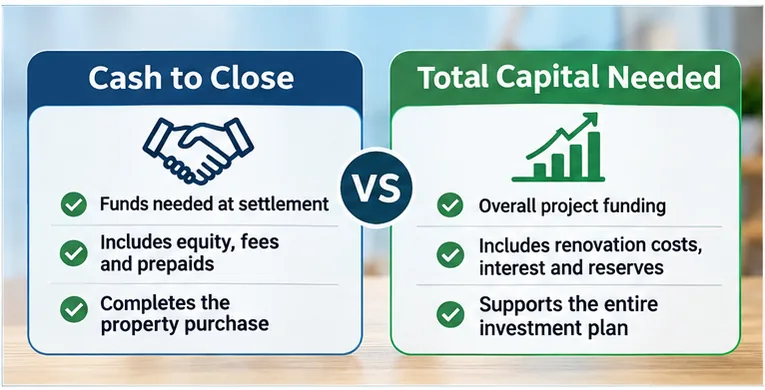
One of the most useful distinctions in investment financing is the difference between the settlement amount and the liquidity required to complete the entire project.
Cash to close represents the funds needed to complete the purchase.
Total project liquidity includes the cash contributed toward the acquisition, funds required during renovation, property carrying expenses, and reserves for project operations.
Continuing the Worcester example, assume the investor also plans for:
| Additional capital requirement | Amount |
|---|---|
| Initial contractor payments before eligible draw reimbursement | $12,000 |
| Working capital for interest, utilities, insurance, and other holding expenses | $18,000 |
| Total planned project reserves | $30,000 |
The investor’s overall capital plan would then include:
Total purchase and closing contribution: $106,500
Additional planned project reserves: $30,000
Total capital contributed or earmarked: $136,500
Of this amount, $10,000 has already been paid as earnest money, $96,500 is due at settlement, and $30,000 remains available for planned project expenses.
The distinction helps investors estimate both the closing wire and the funds they expect to use during the investment.
Project reserves are separate from the actual settlement balance unless a lender specifically requires an escrow or deposit at closing.
How Loan-to-Value and Loan-to-Cost Affect Cash to Close
Hard money lenders use property values and project costs to determine an appropriate financing amount.
Two important measurements are loan to value and loan to cost.
Loan to Value Ratio
Loan to value compares the loan amount with the property value used for underwriting.
For a property valued at $500,000 with a $350,000 loan:
LTV = $350,000 ÷ $500,000 × 100
Loan to value = 70%
The remaining value represents the borrower’s equity position, although the actual cash contribution depends on the acquisition price and financing structure.
Loan to Cost Ratio
Loan to cost, or LTC, compares the financing commitment with the total eligible project cost.
For a purchase and renovation:
Total project cost = Purchase price + Eligible renovation budget
Suppose an investor purchases a property for $350,000 and plans $100,000 in renovations.
Total project cost = $450,000
If a lender provides a $360,000 total commitment:
LTC = $360,000 ÷ $450,000 × 100
Loan to cost = 80%
The investor’s total contribution toward eligible project costs is $90,000, with closing charges, financing expenses, and reserves considered separately.
Loan to cost and loan to value serve different purposes. The applicable financing amount may also be influenced by the property’s projected completed value.
After Repair Value and Its Role in Financing
After repair value, commonly called ARV, is the estimated value of a property after planned improvements are completed.
A lender may use ARV to evaluate the proposed loan against the projected value of the renovated property.
For example, a property purchased for $350,000 with a $100,000 renovation budget might have an estimated after repair value of $600,000.
The acquisition cost, proposed improvements, and supported completed value each contribute information to the financing review.
Borrowers can better understand these structures by reviewing the available Massachusetts acquisition, renovation, and bridge loan programs.
The important cash planning question is how much of the approved commitment will be advanced at settlement and how much will be reserved for future project costs.
How Rehab Holdbacks Affect the Cash Needed for a Hard Money Loan
Renovation financing frequently involves a construction holdback.
A holdback is the portion of an approved loan reserved for eligible improvements. Funds are typically released through a defined draw process as construction progresses.
For example, a lender might approve a $300,000 total commitment consisting of:
Initial purchase advance: $250,000
Renovation holdback: $50,000
The borrower receives the benefit of the $250,000 purchase advance at closing. The remaining $50,000 becomes available through the agreed construction funding process.
How Construction Draws Work
A typical renovation draw process includes documenting completed work, requesting a release, satisfying any inspection or verification requirements, and receiving the approved funds.
The agreement determines the conditions for payment.
Some programs operate through reimbursement, meaning the investor initially pays eligible expenses and requests a draw after the relevant work has been completed.
Other arrangements may permit different payment structures.
This is why investors should review both the total renovation funding commitment and the practical timing of fund releases.
The availability of renovation financing can support a project’s capital structure, while sufficient working capital helps coordinate material purchases, contractor schedules, and project milestones.
Are Hard Money Loan Closing Costs Separate From Interest Payments?
Yes. Closing expenses and interest payments describe different parts of the financing cost.
Origination fees, legal charges, title expenses, and recording fees are generally associated with arranging and completing the loan and property transaction.
Interest is the cost of borrowing money over time.
Many hard money loans use interest only monthly payments, with the principal becoming due according to the loan agreement.
For example, assume a $300,000 outstanding balance with a 12% annual interest rate.
Annual simple interest at a constant balance = $36,000
Monthly interest using a simple annual rate divided by twelve = $3,000
This calculation illustrates the payment concept. Actual interest depends on the note’s day count convention, outstanding balance, funding dates, and other contractual provisions.
Interest on Renovation Funds
An additional consideration is whether the lender calculates interest on the full committed amount or on funds actually advanced.
For a loan with a construction holdback, the two methods can produce different borrowing costs.
Reviewing the interest calculation method helps investors understand the financing expense throughout the renovation period.
Interest Reserves and Escrows
Some financing arrangements also use an interest reserve or escrow account.
An interest reserve consists of funds set aside to make interest payments during an agreed period.
A reserve may be funded through the borrower’s contribution, retained loan proceeds, or another approved structure.
The closing statement and loan agreement should clarify how the reserve is funded, when the money is used, and how it affects the amount available at settlement.
What Makes Massachusetts Investment Property Closing Costs Different?
The underlying financing calculation is similar across many real estate markets, but the settlement process also reflects local property records, legal requirements, and municipal charges.
Massachusetts investors benefit from considering these details early.
Attorney Coordinated Real Estate Closings
Real estate attorneys play a central role in many Massachusetts closings.
Their work may involve reviewing the purchase agreement, examining title, coordinating mortgage documents, arranging settlement funds, and recording instruments.
Knowing which services are included in the attorney’s fee helps create a complete closing budget.
Municipal Taxes and Property Adjustments
Real estate tax adjustments may depend on the municipality, payment schedule, and settlement date.
For example, the tax proration for a property in Boston may involve different billing details from a property in Worcester or Brockton.
Water charges, municipal lien information, and condominium assessments may also affect the closing statement where applicable.
The purchase and sale agreement determines how various costs and adjustments are allocated between the parties.
Multifamily Property Considerations
Massachusetts investors frequently evaluate two-family and three-family residential properties.
For these properties, the closing review may include existing tenancies, rent adjustments, security deposit accounting, insurance requirements, and the property’s authorized use.
The closing attorney and other relevant professionals can explain how any applicable tenant related funds or contractual adjustments appear on the settlement statement.
Renovation and Construction Planning
For investment properties requiring substantial improvements, the project budget may also involve permitting, insurance, contractor scheduling, and the timing of construction draws.
For example, an investor renovating a multifamily property in Greater Boston may need to coordinate municipal approvals and staged contractor payments.
These matters are part of the broader project liquidity plan rather than automatically becoming cash to close charges.
The structure of private lending for Massachusetts real estate investors can vary according to the property, acquisition purpose, renovation scope, and proposed repayment strategy.
How to Calculate Your Cash to Close Before Settlement
An investor can prepare a preliminary cash to close estimate as soon as the purchase price and proposed financing terms are available.
The following process helps organize the figures.
Step 1: Confirm the Actual Closing Advance
Identify the lender’s approved total commitment and the specific amount that will be applied to the purchase at settlement.
For renovation financing, record any construction holdback separately.
Step 2: Calculate the Borrower Contribution
Subtract the purchase advance from the contract price to determine the equity required toward the acquisition.
Step 3: Identify Every Loan Related Fee
Review the origination points, any applicable broker fees, processing charges, and other financing expenses.
Confirm whether each fee is payable separately or deducted from the loan proceeds.
Step 4: Add Settlement and Prepaid Expenses
Include the attorney’s charges, title expenses, recording fees, required insurance payments, tax adjustments, and applicable escrows.
Use the most recent itemized estimate prepared for the transaction.
Step 5: Apply Deposits and Approved Credits
Account for earnest money previously deposited, approved seller contributions, and any other credits reflected in the settlement agreement.
Step 6: Review the Final Funds Due
Compare the preliminary calculation with the final settlement statement.
The closing attorney or settlement coordinator should confirm the amount payable and the approved instructions for transferring funds.
Verifying wiring instructions through independently confirmed contact information is an important part of secure settlement coordination.
What Documents Help Determine the Final Cash to Close Amount?
Several documents provide the figures used in an accurate closing calculation.
Purchase and sale agreement: Establishes the purchase price, deposit, closing date, and negotiated allocation of expenses.
Loan commitment letter: Describes the approved loan amount, applicable fees, and funding conditions.
Property valuation: Provides information supporting the lender’s assessment of the collateral.
Construction budget: Explains the proposed improvements and estimated renovation expenses.
Title and attorney fee estimates: Identify legal, title, and settlement related charges.
Insurance documentation: Confirms applicable coverage and the premiums payable before or at closing.
Settlement statement: Provides the final accounting of the transaction, including funds received, charges, credits, and the balance due.
The borrower information and financing process also illustrates the types of property and transaction details used when reviewing an investment loan request.
How Can Investors Plan Their Cash to Close More Accurately?
A useful closing budget separates the transaction into three financial categories.
Capital Required Before Closing
This category includes earnest money, property due diligence, and any valuation or administrative costs collected before settlement.
Recording these payments helps ensure they are properly reflected in the final transaction accounting.
Capital Required at Closing
This includes the remaining equity contribution, financing charges, settlement expenses, and required prepaid amounts after applicable credits.
The final settlement statement establishes the amount due.
Capital Required After Closing
This category includes planned renovation expenditures, property carrying expenses, interest payments, and reserves for completing the project.
Keeping these amounts separate provides a clearer picture of the investor’s total capital commitment.
It also makes financing comparisons more meaningful because two loan proposals with similar interest rates can have different initial advances, construction funding arrangements, and closing costs.
Frequently Asked Questions About Hard Money Loan Cash to Close Costs
The amount depends on the property purchase price, approved loan advance, origination fees, settlement expenses, prepaid charges, and applicable deposit credits. Calculate the difference between the purchase price and closing advance, add borrower expenses, and subtract amounts already paid or credited.
Some lenders may allow certain expenses to be included in the financing structure, subject to loan limits and approval. Other costs are paid by the borrower at settlement. The loan commitment and closing statement clarify how each expense is funded.
Cash to close includes the remaining down payment plus applicable closing charges and prepaid expenses, adjusted for deposits and credits. The down payment represents only the buyer’s equity contribution toward the purchase.
Hard money loans commonly involve origination fees and third party settlement expenses, such as attorney charges, title services, recording fees, and property valuation costs. The exact items depend on the lender and transaction.
Origination points increase the amount required to complete a transaction when paid by the borrower at settlement. One point equals 1% of the specified loan amount. For a $300,000 loan, a 3% origination fee equals $9,000.
A renovation holdback provides approved funding for future improvements according to the draw agreement. It generally remains separate from the initial purchase advance, so investors should calculate their purchase contribution using the funds actually applied at settlement.
Yes. Earnest money previously paid toward the purchase is generally credited on the settlement statement. For example, a $15,000 earnest money deposit reduces the remaining amount due by $15,000 when fully credited.
Seller contributions may reduce eligible buyer expenses when permitted by the purchase agreement and financing terms. The approved amount appears as a credit on the settlement statement.
For refinancing, the calculation considers the proceeds of the new loan, existing mortgage payoff, accrued interest, applicable loan charges, settlement expenses, and required escrows. Depending on these figures, the borrower may receive net proceeds or contribute additional funds.
Cash to close is the amount needed to complete the transaction at settlement. Total loan cost includes applicable financing charges over the borrowing period, including interest and other contractual fees. Total project capital also accounts for the investor’s equity and ongoing property expenses.
Final Thoughts: Understand the Full Cash Requirement Before Closing
Hard money loan cash to close costs become easier to calculate when the purchase contribution, loan origination charges, title expenses, prepaid items, and settlement credits are considered individually.
For Massachusetts real estate investors, the most important number is the actual amount required at settlement based on the approved loan advance and final closing statement.
A complete financial plan also accounts for renovation draws, working capital, interest payments, and property holding expenses.
Understanding the distinction between the total loan commitment, funds advanced at closing, and capital needed throughout the project allows investors to evaluate financing structures with greater clarity and prepare for each stage of their investment.